European Software-Defined Storage
SanbrickOS
The software that puts your data under your control — on any hardware, to European standards.
Software-Defined Storage built in Portugal. Runs on existing or new hardware. Unifies NAS and SAN in a single platform. No vendor lock-in. No surprises on your invoice.
Architecture and Technical Capabilities
One platform. NAS and SAN. Any hardware.
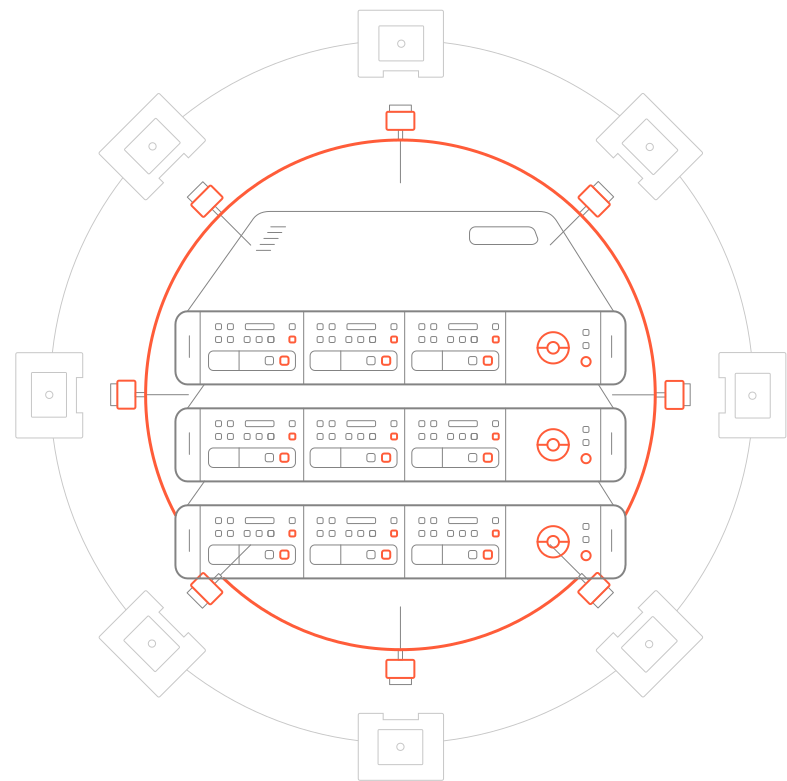
SanbrickOS is a Linux-based Software-Defined Storage platform that abstracts the management layer from the underlying hardware. The result: a unified interface for managing NAS and SAN protocols, regardless of server manufacturer
Three-Layer Architecture

Hardware layer
Any certified x86 server. Dell, HP, Supermicro, Lenovo, existing hardware. No dependency on proprietary controllers.
SanbrickOS layer
Unified management engine. Volume logic, RAID, snapshotting, replication, and access policies on a single platform. Responsive web interface, available in multiple languages.
Services and protocols layer
Exposure of storage services to clients and existing systems, with native support for the main enterprise protocols.
Four Strategic Advantages

Hardware Freedom
Install on Dell, HP, Supermicro, Lenovo or any x86 platform. Change hardware vendor whenever it suits you. Competition between hardware suppliers works in your favour — not in your software vendor’s.


European Data Sovereignty
Your data stays in infrastructure you control, under European jurisdiction. GDPR compliance by architecture, not by declaration. No exposure to US Cloud Act legislation. No “regions” managed by third parties.
Predictable Costs Over 5 Years
Unlike cloud, which grows with your data, SanbrickOS has a stable cost model. Sanbrick clients report average savings of 244% compared to equivalent cloud solutions over 5 years.


Growth Without Disruption
Scale capacity without downtime, without forced forklift upgrades, without mandatory refresh cycles. Add what you need, when you need it, without asking your vendor for permission.
Licensing Models
The flexibility your business needs
SanbrickOS is available in three investment models. The software is the same the model adapts to how your organisation prefers to invest.
One-time purchase, permanent ownership
Ideal for organisations that prefer capital expenditure, with the lowest TCO over 5+ years. The software is yours. Major version upgrades carry a separate cost; security updates and maintenance are included in the support plan.
From €1,866
Operational licensing, always up to date
Ideal for organisations that prefer operating expenditure or that value always having the latest version included. Annual cost based on capacity and feature set.
Pricing on request
Perpetual core infrastructure, subscription-based expansion
Ideal for growing organisations that want stability at the core and flexibility in expansion. The best of both models combined.
Pricing on request
Meet SanbrickOS
Download SanbrickOS datasheet
Full specifications, certified hardware list, system requirements, release notes.
Software-defined. Hardware-independent. European-engineered.
SanbrickOS and you
The software that separates your data from the hardware that holds it

Storage Capabilities
Minimum Hardware Requirements
CPU
Minimum
- x86_64, 2 cores
Recommended
- 4+ dedicated cores
Memory
Minimum
- x86_64, 2 cores
Recommended
- 4+ dedicated cores
Network
Minimum
- x86_64, 2 cores
Recommended
- 4+ dedicated cores
Boot Device
Minimum
- x86_64, 2 cores
Recommended
- 4+ dedicated cores
Storage Media
Minimum
- x86_64, 2 cores
Recommended
- 4+ dedicated cores
Four series. One platform.
Choose by workload, not by size
Every series runs the same SanbrickOS platform. The difference is the architecture — each series is purpose-built for a specific workload profile and operational requirement.

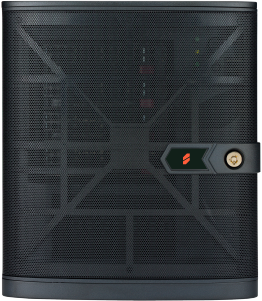
Local Edge Storage
SanbrickOS in a compact format for edge deployments, branch offices and local data environments. The right architecture when simplicity, proximity to operations and direct support matter more than scale.
- Edge and branch office deployments
- Local backup and data retention
- Small installations with proximity requirements
- Environments where operational simplicity is a priority
From €2500


Compact Performance Storage
1U performance for workloads where rack footprint, speed and simplicity all count. Supports 2.5″ SATA, SAS and NVMe — the natural fit for fast file and block services without the complexity of larger chassis.
- Light to medium virtualisation
- Fast file and block services
- Small and edge data centres
- Workloads requiring a reduced physical footprint
From €15000

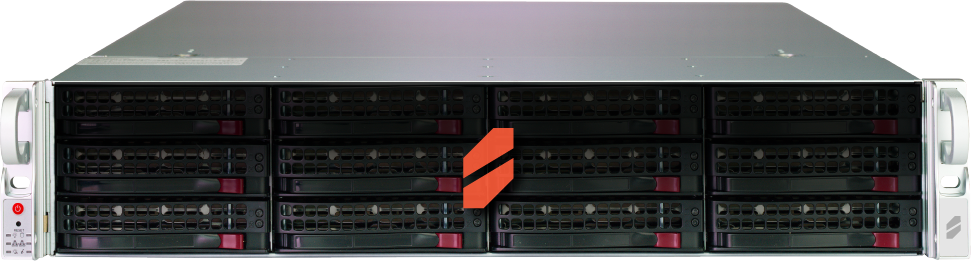
Core & Capacity Storage
The primary Sanbrick appliance for enterprise workloads — available in three configurations, each optimised for a distinct storage profile: core capacity, high density, or all-flash performance.
- Magnetar 12L — Core Capacity: backup, file services, archive, general-purpose
- Magnetar 36L — Dense Capacity: large volumes, maximum €/TB efficiency
- Magnetar 24S — All-Flash Performance: virtualisation, databases, VDI
Configuration on request

High Availability Storage
Sanbrick’s dedicated architecture for environments where service continuity is non-negotiable. Every Quasar configuration is a validated two-node cluster — purpose-built to keep critical services running regardless of individual system failure.
- Quasar HA Capacity: two nodes + 12 × 3.5″ JBOD — HA for backup and capacity
- Quasar HA Performance: two nodes + 24 × 2.5″ JBOD — HA for critical virtualisation
- Quasar HA NVMe: two nodes + 24 × U.2 NVMe — all-flash HA for private cloud
Configuration on request
Meet SanbrickOS
Download SanbrickOS datasheet
Full specifications, certified hardware list, system requirements, release notes.
Software-defined. Hardware-independent. European-engineered.
Frequently asked questions
Everything you need to know about SanbrickOS
Any x86-64 server from Dell, HP, Supermicro, Lenovo or similar manufacturers that meets the minimum requirements — 4 cores, 16 GB RAM, dual 1GbE. It also runs on Sanbrick appliances, pre-installed and certified.
No. It is purpose-built enterprise storage software, engineered specifically for unified NAS and SAN management — not adapted from a general-purpose Linux distribution.
Yes. SMB/CIFS, NFS and AFP for NAS; iSCSI, Fibre Channel and FCoE for SAN — all managed through the same interface, on the same hardware.
Immutable snapshots that cannot be encrypted or deleted by ransomware, combined with role-based access control and full audit logging of every access event.
Yes, using SanbrickOS replication features to seed data in the background and cut over during a scheduled maintenance window — most migrations complete with minutes, not hours, of service interruption.
Nothing changes on the software side. SanbrickOS is hardware-independent by design — install it on a different manufacturer’s server and continue operating with the same configuration and licence.
SanbrickOS itself does not transmit data outside the infrastructure you control. Combined with hosting on European soil, this removes any US Cloud Act exposure by architecture, not by policy.
Licences are issued per node. Add capacity or additional nodes at any time — there is no forced tier upgrade or renegotiation of your existing contract.
All three models include access to the SanbrickOS knowledge base; OpEx and Managed models bundle standard support directly. See the Support Plans page for full tier detail.
Yes — certified integrations exist for VMware vSphere, Microsoft Hyper-V and Citrix Hypervisor, alongside native Active Directory/LDAP and Veeam Backup support.
Book a free infrastructure audit. A Sanbrick engineer reviews your current environment and proposes a SanbrickOS deployment plan — no obligation, no cost.
Ready to Take Control of Your Data?
For business decision-makers:
We offer a no-commitment validation process in three steps
- Free Audit – Infrastructure, cost, and compliance analysis. Written report included. 1–2 weeks
- Live Demo – SanbrickOS in action with your use cases. Technical teams welcome. 2-hour session
- Pilot Project – Test non-critical systems. Performance data from your environment. 30 to 90 days
For technical teams:
- Download the full SanbrickOS technical documentation – specifications, certified hardware list, system requirements, and implementation guide.
